
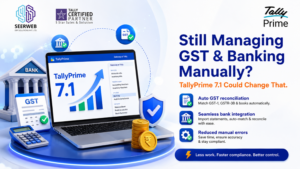
Small and medium-sized businesses today operate in an environment where accounting is no longer limited to bookkeeping. Businesses are expected to manage GST compliance, banking reconciliation, inventory tracking, vendor payments, and reporting — all while maintaining operational efficiency.
For many SMEs, the workload surrounding accounting and compliance continues to increase. GST processes involve frequent reconciliation, invoice verification, return filing timelines, and maintaining accurate transaction records. At the same time, banking operations have become more transaction-heavy, making reconciliation and payment tracking increasingly time-consuming when handled manually.
Many SMEs spend more time managing accounting operations than analyzing business performance.
As business expectations continue to shift toward faster reporting and better financial visibility, the demand for automation is growing. Businesses are increasingly looking for accounting systems that can simplify repetitive processes, reduce manual intervention, and improve accuracy across financial operations.
Why Banking & GST Automation Is Becoming Essential?
Modern businesses are expected to operate in real time. Customers, vendors, accountants, and management teams often expect faster financial updates, quicker reconciliations, and immediate access to transaction data. This has increased pressure on SMEs to maintain accounting systems that support speed and accuracy.
GST compliance timelines also leave very little room for delays. Businesses must regularly reconcile invoices, verify purchase and sales entries, and prepare returns within defined deadlines. Manual workflows can make this process slower and more error-prone, especially as transaction volumes increase.
At the same time, operational efficiency has become a major focus area for growing businesses. SMEs are trying to reduce repetitive administrative tasks so teams can focus more on business planning, customer management, and financial decision-making.
There is also significantly lower tolerance for manual accounting errors today. Incorrect entries, delayed reconciliations, or mismatched invoices can directly affect compliance accuracy, vendor coordination, and reporting reliability. As a result, automation is increasingly becoming part of everyday accounting requirements rather than an optional enhancement.
Common Accounting Problems SMEs Still Face
1. GST Filing & Reconciliation Errors
Many SMEs still face challenges while managing GST reconciliations and return preparation. Invoice mismatches between purchase records and supplier filings can create reconciliation complications. Missing entries and incomplete transaction recording can further affect compliance accuracy.
Filing delays are another common concern, particularly when businesses rely heavily on manual verification processes. As transaction volumes increase, reviewing and matching invoices manually becomes more difficult and time-consuming.
2. Manual Banking Processes
Bank reconciliation continues to be one of the most time-intensive accounting activities for many SMEs. Businesses often manually match transactions with bank statements, which increases the possibility of missed entries or reconciliation errors.
Vendor-related transaction confusion can also occur when payment references are unclear or when multiple transactions require verification. These manual processes may delay financial closure and increase accounting workload.
3. Delayed Financial Reporting
Month-end reporting pressure remains a major operational challenge for many businesses. When reconciliations, entries, and adjustments are delayed, businesses may not receive timely financial insights.
Slow reporting can impact business decisions related to cash flow, payments, procurement, and operational planning. Delays in financial visibility may also affect management’s ability to respond quickly to changing business conditions.
4. Inventory Management Issues
Inventory-related accounting issues continue to affect many SMEs, especially businesses operating across multiple warehouses or locations. Stock mismatches between physical inventory and accounting records can create reporting inconsistencies.
Managing inventory movement across different locations may also become difficult when systems are not fully synchronized, leading to confusion in stock visibility and operational coordination.
Expected GST Improvements in TallyPrime 7.1
1. Smarter Validation & Error Detection
TallyPrime 7.1 is expected to bring improvements focused on smarter GST validation and error detection processes. Possible automation enhancements may help businesses identify mismatches and inconsistencies more efficiently during reconciliation activities.
Improved validation mechanisms could also support better reconciliation accuracy by reducing dependency on manual verification processes. This may help businesses minimize filing errors and improve compliance readiness.
Reduced manual checking could become particularly useful for SMEs handling large volumes of invoices and transactions on a regular basis.
2. Faster GST Workflow Management
Businesses may also expect improvements aimed at simplifying GST workflow management. Faster reconciliation processes and more streamlined compliance preparation could help reduce the time spent on routine filing activities.
Quicker workflows may help businesses prepare GST returns more efficiently while reducing operational pressure during filing periods.
Businesses are no longer looking for basic compliance tools — they want systems that actively reduce operational effort.
3. Banking Automation Features Businesses May Expect
Businesses may expect several banking automation improvements, including:
- Transaction synchronization
- Connected banking improvements
- Better payment visibility
- Automated reconciliation support
These features could help SMEs reduce the amount of manual accounting work involved in daily banking operations. Instead of manually tracking transactions across multiple systems, businesses may benefit from more centralized visibility and faster verification processes.
Improved banking automation may also support better cash flow visibility by helping businesses monitor payments, receipts, and outstanding transactions more efficiently. Over time, this can contribute to smoother financial operations and improved operational efficiency.
How Different SMEs Could Benefit
A. Retailers
Retail businesses may benefit from improved billing efficiency and better payment tracking. Faster transaction recording and streamlined reconciliation processes could help retailers manage high transaction volumes more effectively.
B. Manufacturers
Manufacturing businesses may gain better visibility into production-related accounting and vendor reconciliation processes. Improved financial coordination may support better operational planning and payment management.
C. Distributors
Distributors handling multiple warehouses and large outstanding cycles may benefit from improved warehouse coordination and better outstanding management visibility. Centralized accounting workflows could help reduce operational confusion.
D. CA & Accounting Firms
CA firms and accounting professionals may experience faster client processing and simplified compliance management workflows. Improved automation may help reduce repetitive tasks while improving overall processing efficiency.
What Businesses Should Review Before Upgrading
Before upgrading, businesses should carefully review their existing accounting environment and operational readiness.
Areas businesses should evaluate include:
- Existing TDLs and customizations
- Data quality and accuracy
- Pending reconciliations
- Backup readiness
- Cloud environment setup
- Employee training requirements
Businesses should also ensure that testing is completed before full migration. Reviewing compatibility, validating workflows, and testing accounting processes in advance can help reduce operational disruption during implementation.
Why Professional Upgrade Support Can Help
Professional upgrade support can help businesses manage the transition process more smoothly. Upgrades often involve reviewing compatibility requirements, assessing existing customizations, and planning migration activities carefully.
Support teams can also help businesses reduce downtime during implementation and ensure accounting workflows continue operating with minimal disruption. Businesses using customized environments may particularly benefit from reviewing TDL compatibility and operational dependencies before upgrading.
Remote support can further assist businesses in handling setup, troubleshooting, reconciliation reviews, and user guidance during the transition process.
For SMEs looking to modernize accounting workflows, structured upgrade planning can help ensure better stability and operational continuity.
Final Thoughts
Accounting automation is increasingly becoming a business necessity rather than an optional improvement. As GST compliance requirements and banking operations continue to evolve, SMEs are under growing pressure to improve efficiency, reduce manual effort, and maintain better financial visibility.
TallyPrime 7.1 is expected to support this shift toward workflow modernization through improved GST and banking automation capabilities.
Businesses should focus not only on upgrading software, but also on preparing their systems, workflows, and teams for smoother operational transformation.
FAQs
1. Will TallyPrime 7.1 improve banking automation?
TallyPrime 7.1 is expected to introduce improvements related to banking automation, including transaction synchronization, connected banking enhancements, and automated reconciliation support.
2. Is TallyPrime 7.1 useful for small businesses?
Yes, SMEs may benefit from workflow simplification, reduced manual accounting effort, improved reconciliation processes, and better operational visibility.
3. Can businesses use existing data after upgrading?
Businesses generally review existing data, backups, and compatibility requirements before upgrading to ensure smooth migration and continuity.
4. Will TDL customizations need changes?
Businesses using existing TDL customizations should review compatibility before upgrading, as some custom environments may require adjustments or testing.
5. How should SMEs prepare before upgrading?
SMEs should review data quality, pending reconciliations, backups, cloud setup, employee training requirements, and customization compatibility before implementation.